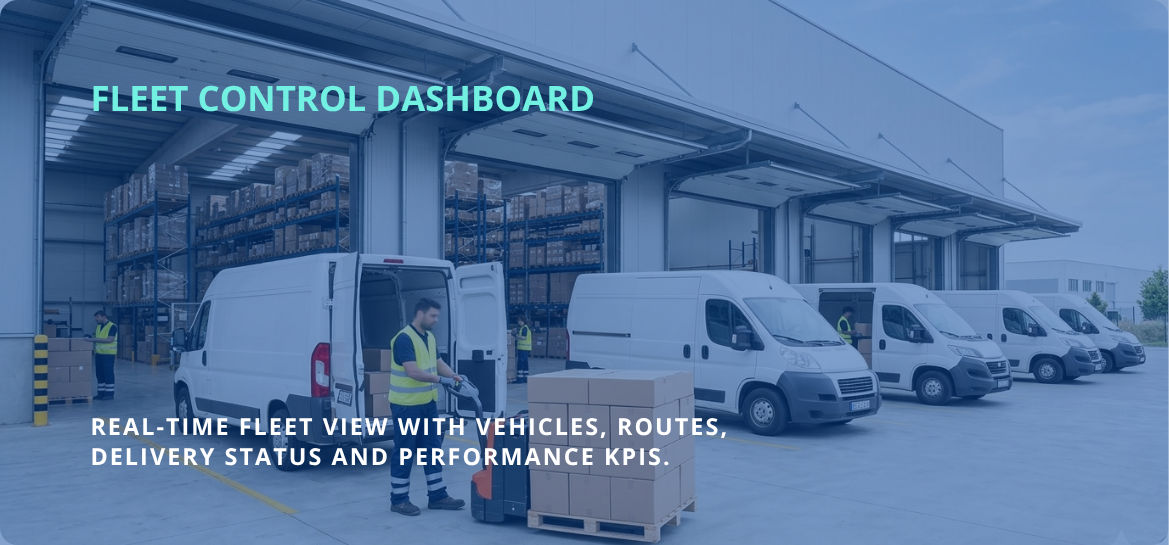
Optimizing Fleet Management for Efficiency Gains
Enterprise fleet management is about managing a company’s vehicle fleet in the most cost-effective, timely and environmentally responsible way.
Today, it includes much more than basic vehicle administration. It covers:
- Route optimization
- Driver behavior management
- Vehicle maintenance
- Real-time monitoring
- Strategic coordination across teams
- Compliance with customer and regulatory requirements
Fleet management is not simply a back-office activity. It directly affects service quality, delivery reliability, resource use and business scalability.
Why Fleet Management Matters
As fleets expand, the number of variables increases.
Manual planning becomes less sustainable, and companies need connected systems that help managers, dispatchers, drivers and clients work with more reliable information.
This improves responsiveness across the supply chain and reduces the operational uncertainty that often affects large fleets.
It also helps standardize execution across:
- Teams
- Sites
- Regions
- Routes
- Operational processes
This makes growth more controlled and consistent.
The Role of Enterprise Fleet Management
Enterprise fleet management is a foundation of operational effectiveness in logistics.
It involves planning, monitoring and administering vehicles to improve efficiency and reduce expenses.
As ecological concerns and market demands evolve, fleet management must also support:
- Innovation
- Continuous improvement
- Better resource allocation
- Lower operational waste
- More sustainable logistics practices
By using data and analytics, companies can better understand driver behavior, vehicle performance and fuel consumption.
This supports stronger decision-making and greater operational control.
Common Fleet Management Challenges
Manual planning and execution often create inefficiencies for logistics managers.
Processes based on Excel sheets, paperwork and disconnected tools increase the risk of mistakes.
They can also make it harder to respond quickly to road, loading or unloading problems.
Lack of Real-Time Visibility
Supply chain directors need end-to-end visibility.
Without real-time data, companies may struggle to:
- Track goods in transit
- Respond to market changes
- Coordinate teams effectively
- Maintain service standards
- Identify operational bottlenecks
Fragmented Processes
CEOs also face the challenge of scaling operations across regions.
When workflows are manual and fragmented, growth becomes harder to manage.
An integrated strategy improves operational coherence and makes fleet management more scalable.
How Technology Improves Fleet Management
Technology has changed how fleet management works.
Modern solutions provide automated dispatching, centralized dashboards and real-time analytics that improve decision-making.
These tools help companies:
- Reduce planning time
- Improve service quality
- Strengthen communication
- Remain responsive and competitive
- Increase transparency with clients
GPS tracking and mobile applications provide delivery updates that increase visibility and trust.
AI and machine learning can also analyze fleet data to reveal patterns, insights and improvement opportunities that were previously harder to detect.
Real-Time Monitoring and Automation
Real-time monitoring gives logistics managers visibility into:
- Vehicle location
- Driver performance
- Delivery status
- Route progress
- Possible disruptions
This supports proactive management and faster problem-solving.
Automation reduces manual intervention in processes such as:
- Dispatching
- Delivery confirmation
- Vehicle loading
- Route planning
- Scheduling
By automating repetitive tasks, businesses can focus more on long-term planning and strategic initiatives.
Automation can also improve routes and schedules, lowering fuel consumption and emissions.
Centralized Data and KPI Tracking
Centralized data and real-time reporting are essential for executives.
A strong Transport Management System (TMS) provides one platform for tracking performance indicators such as:
- Delivery efficiency
- Depot productivity
- Fleet utilization
- Route performance
- Service quality
This supports agile decision-making, strategic growth and better operational visibility.
Centralized data also helps with benchmarking and performance evaluation.
By continuously monitoring KPIs, businesses can identify improvement areas, maintain service standards and remain competitive in a changing industry.
Fleet Maintenance as a Key Efficiency Factor
Effective fleet maintenance is essential for optimization.
It helps reduce downtime, improve safety, extend vehicle lifespan and protect operational continuity.
Routine inspections and timely repairs prevent minor issues from becoming major problems.
A well-maintained fleet also supports customer satisfaction and company reputation. It shows a commitment to quality, reliability and professionalism.
Predictive Maintenance
Predictive maintenance uses data analytics to anticipate vehicle problems before they occur.
By reviewing trends and performance metrics, logistics managers can:
- Schedule maintenance proactively
- Reduce unplanned breakdowns
- Lower repair costs
- Improve service dependability
- Protect delivery continuity
IoT devices and sensors can monitor tire pressure, engine performance and other critical parameters in real time.
This data helps predict maintenance needs, improve safety and reduce environmental impact.
Sustainability in Fleet Management
Sustainability in fleet management is now a business requirement.
Reducing carbon footprint, switching to eco-friendly vehicles, optimizing routes for fuel efficiency and following environmental rules are essential for competitiveness.
Companies can strengthen sustainability initiatives through:
- Electric or hybrid vehicles
- Driver training for fuel-efficient driving
- Telematics to track emissions
- Route optimization to reduce unnecessary mileage
- Better maintenance to improve vehicle efficiency
These actions can improve brand image and support more responsible logistics operations.
Scaling Fleet Operations Efficiently
For CEOs and supply chain directors, scaling operations efficiently is a major concern.
A scalable fleet management system supports multi-site and multilingual environments, helping companies:
- Maintain consistency across regions
- Serve a growing customer base
- Enter new markets
- Adapt to changing demand
- Support long-term growth
Scalable solutions allow businesses to respond quickly to changes in demand or market conditions.
Flexible systems help companies stay agile, competitive and ready for future expansion.
Integrated Workflows from Yard to Last Mile
Integrated workflows simplify processes from yard management to last-mile delivery.
By connecting dispatch, loading and delivery on one platform, businesses can reduce bottlenecks and maintain smooth operations as they expand.
Integrated workflows also improve resource allocation.
Better coordination helps reduce duplication, lower operating costs and increase productivity while supporting customer needs.
Customization and Compliance
Customizable templates for scanning, temperature logs and proof of delivery allow businesses to adapt fleet management to specific requirements.
This supports:
- Compliance with industry standards
- Productivity
- Service quality
- Operational consistency
- Faster adaptation to regulatory changes
Customizable solutions also help companies respond to new market opportunities.
This flexibility is essential in modern logistics.
Fleet Management as a Competitive Advantage
For logistics executives, fleet management optimization is about strategic growth and sustainability, not only operational efficiency.
By adopting advanced technologies and creative approaches, companies can turn fleet management from a logistical challenge into a competitive advantage.
Long-term success requires resilient and flexible operations aligned with broader business goals.
Logistics executives should optimize current processes while also exploring new opportunities for growth and innovation.
ROI and Long-Term Value
Investing in a comprehensive fleet management system such as CADIS can generate a quick return on investment.
By reducing errors and saving more than 40 minutes per dispatcher per day, companies can achieve cost savings and efficiency gains that support further improvements.
A fast ROI also strengthens stakeholder confidence.
Demonstrating measurable benefits helps build support for future projects and encourages a culture of innovation and high performance.
Conclusion: Building a Smarter Fleet Management Model
Fleet management optimization requires strategic planning, technology and sustainability initiatives.
By addressing common challenges, adopting advanced solutions and encouraging continuous improvement, businesses can improve efficiency, profitability and long-term growth.
A digital, data-driven approach helps organizations make informed decisions, optimize resources and respond faster to market changes.
As businesses continue to evolve, the ability to innovate and adapt will remain essential for maintaining a competitive edge and achieving long-term success.